Baylink urban redevelopment of Port of Melbourne

Port Phillip Bay Link

Port Phillip Bay LinkPort Phillip Bay LinkPort Phillip Bay Link
ENGAGE WITH US

Port Phillip Bay Link

Port Phillip Bay LinkPort Phillip Bay LinkPort Phillip Bay Link
ENGAGE WITH US

Urban Development

Relocating the port to offshore platforms frees the existing Port of Melbourne precinct — 480 hectares of inner-urban land within 3 km of the CBD — for redevelopment as part of a major urban development project. This creates one of the largest urban renewal opportunities in Australian history, with capacity for new housing, commercial precincts, and public open space, while reducing urban sprawl and alleviating the disproportionate development of existing suburbs.


With new road links across Baylink and improved Port Phillip Bay infrastructure, travel times and congestion are significantly reduced. Additionally, reduced dredging in the bay enhances the marine environment, contributing to better quality of life for all Victorians.

the case for baylink


Key Benefits

BAYLINK addresses Victoria's most critical long-term infrastructure challenges — congestion, port capacity, housing supply, and environmental legacy.

Housing Supply

New inner urban redevelopment to house half a million people — unlocking the current port precinct as one of the largest urban renewal opportunities in Australian history, reducing urban sprawl and creating vibrant communities close to the CBD.


Green Industry Platforms

Increased economic activity and productivity — the offshore platforms hosting port facilities also provide space for green industries, data centres, clean manufacturing, and emerging technologies, creating a new economic zone in Port Phillip Bay - away from populations and preserving land.


West Gate Congestion Relief

Travel time savings of up to 76 minutes and a direct alternative to the West Gate Bridge — reducing congestion and improving the resilience of Victoria's transport network.


Port Capacity & Automation

A more efficient and infinitely expandable port facility — purpose-built offshore platforms replace the landlocked Port of Melbourne, future-proofing Victoria's trade gateway for generations to come.


Yarra River Dredging

Relocating the port from the Yarra River achieves a 95% reduction in dredging of the Bay — improving the marine ecosystem and delivering a lasting environmental benefit for Port Phillip Bay.


Rail & Road Connectivity

BAYLINK delivers dedicated road and rail corridors across Port Phillip Bay. The BayWest and BayCentral alignments include rail connections to the west of the Bay, primarily serving freight transport — opening up regional Victoria to greater economic activity and productivity.


Solving Victoria's most critical challenges.

Housing Supply

Relocating the port to offshore platforms frees the existing Port of Melbourne precinct — 480 hectares of inner-urban land within 3 km of the CBD — for redevelopment as part of a major urban development project. This creates one of the largest urban renewal opportunities in Australian history, with capacity for new housing, commercial precincts, and public open space, while reducing urban sprawl and alleviating the disproportionate development of existing suburbs.

Sustainability

The Baylink project's offshore platforms enhance Port Phillip Bay infrastructure by providing opportunities for green industries, such as solar energy, waste-to-energy power generation, and battery storage. This urban development project will significantly reduce Victoria's reliance on fossil fuels, lower CO2 emissions, and minimize the amount of waste sent to landfill, all while avoiding the use of existing land and locating such assets away from populated areas.

West Gate Congestion

The new Baylink crossing enhances Port Phillip Bay infrastructure by alleviating Victoria's most congested freight and commuter corridor, ultimately unlocking the state's west through this vital urban development project.

Port Capacity

With the Baylink urban development project, Victoria's trade gateway significantly enhances its capacity and efficiency, thereby securing the state's economic competitiveness for the next century.

Yarra River Dredging

Relocating the port from the Yarra River, as part of the Baylink urban development project, achieves a 95% reduction in bay dredging. This relocation eliminates the need to dredge the Yarra, enhancing the habitat for marine life and delivering lasting environmental benefits for Port Phillip Bay.

Economic growth

In the face of economic uncertainty and unsustainable State debt, the Baylink project has a strong business case and should primarily be funded by federal funding and private investment. This urban development project will, in turn, underpin economic growth and prosperity in Victoria through enhanced Port Phillip Bay infrastructure and improved Victoria transport solutions for decades to come.

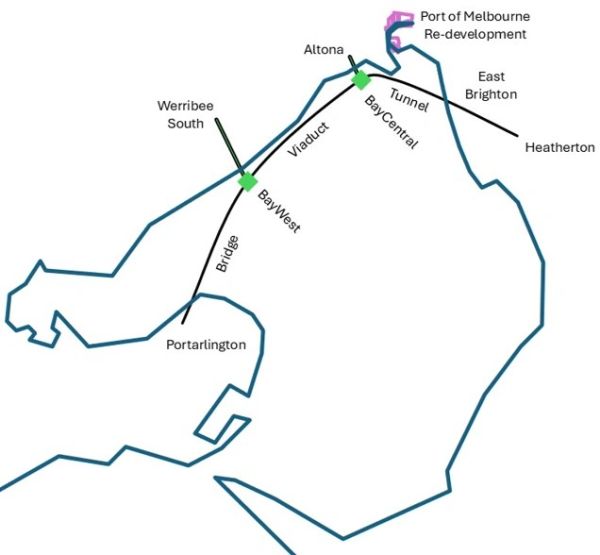
Map of Baylink re-development with key transport points.

Overview

Relocating the port to offshore platforms frees the existing Port of Melbourne precinct — 480 hectares of inner-urban land within 3 km of the CBD — for redevelopment as part of a major urban development project. This creates one of the largest urban renewal opportunities in Australian history, with capacity for new housing, commercial precincts, and public open space, while reducing urban sprawl and alleviating the disproportionate development of existing suburbs.


With new road links across the Baylink and improved Port Phillip Bay infrastructure, travel times and congestion are significantly reduced. Additionally, reduced dredging in the bay enhances the marine environment, contributing to better quality of life for all Victorians.

Digital rendering of container ship and dock loaded with colorful cargo containers.

Offshore Platforms

The Baylink project's offshore platforms enhance Port Phillip Bay infrastructure by providing opportunities for green industries, such as solar energy, waste-to-energy power generation, and battery storage. This urban development project will significantly reduce Victoria's reliance on fossil fuels, lower CO2 emissions, and minimize the amount of waste sent to landfill, all while avoiding the use of existing land and locating such assets away from populated areas.

Baylink immersed tunnel construction

Immersed Tube Tunnel

The new Baylink crossing includes immersed tunnelling methods across the middle of the bay - an efficient and proven method.

Baylink twin bored tunnels

Bored Tunnels

Bored tunnels are proposed under established suburbia for connections to the SouthEast, linking to Nepean Highway and the Mornington Peninsula Freeway.

Baylink dual road viaduct

Viaducts

Road and rail viaducts are proposed for the Northern and Western portions of Baylink - connecting to Melbourne's West, Geelong and Avalon airport - via Princes Freeway, and the Bellarine Peninsula.

the numbers that define a generation

100km+ of new road and rail

100km+ of new road and rail

100km+ of new road and rail

100,000+ new homes

100km+ of new road and rail

100km+ of new road and rail

Unlimited port capacity

ZERO WEST GATE CONGESTION

ZERO WEST GATE CONGESTION

ZERO WEST GATE CONGESTION

ZERO WEST GATE CONGESTION

ZERO WEST GATE CONGESTION

PROJECT STAGES

Stage 1: Business Case & Approvals

Stage 2: BayCentral and Immersed Tunnel Construction

Stage 3: BayWest Construction

Stage 4: Bellarine Connection and Port Expansion

About PPBL

Relocating the port to offshore platforms frees the existing Port of Melbourne precinct — 480 hectares of inner-urban land within 3 km of the CBD — for redevelopment as part of a major urban development project. This creates one of the largest urban renewal opportunities in Australian history, with capacity for new housing, commercial precincts, and public open space, while reducing urban sprawl and alleviating the disproportionate development of existing suburbs.


With new road links across the Baylink and improved Port Phillip Bay infrastructure, travel times and congestion are significantly reduced. Additionally, reduced dredging in the bay enhances the marine environment, contributing to better quality of life for all Victorians.

Location

Baylink connects the Southeast and West of Melbourne and Victoria, via infrastructure arcing across the North of Port Phillip Bay.

Project Type

Baylink is mega infrastructure project.

Funding

Baylink is proposed to be primarily funded by a combination of federal government and private equity investment.

Business Case

Full details of the preliminary business case are available upon request.

Contact Us

We welcome enquiries from government, stakeholders, institutional investors, industry partners, and community representatives.

Attach Files
Attachments (0)

This site is protected by reCAPTCHA and the Google Privacy Policy and Terms of Service apply.

PPBL

Port Phillip Bay Link

Copyright © 2026 Advanced Science and Engineering Pty Ltd - All Rights Reserved.

Powered by

This website uses cookies.

We use cookies to analyze website traffic and optimize your website experience. By accepting our use of cookies, your data will be aggregated with all other user data.

Accept